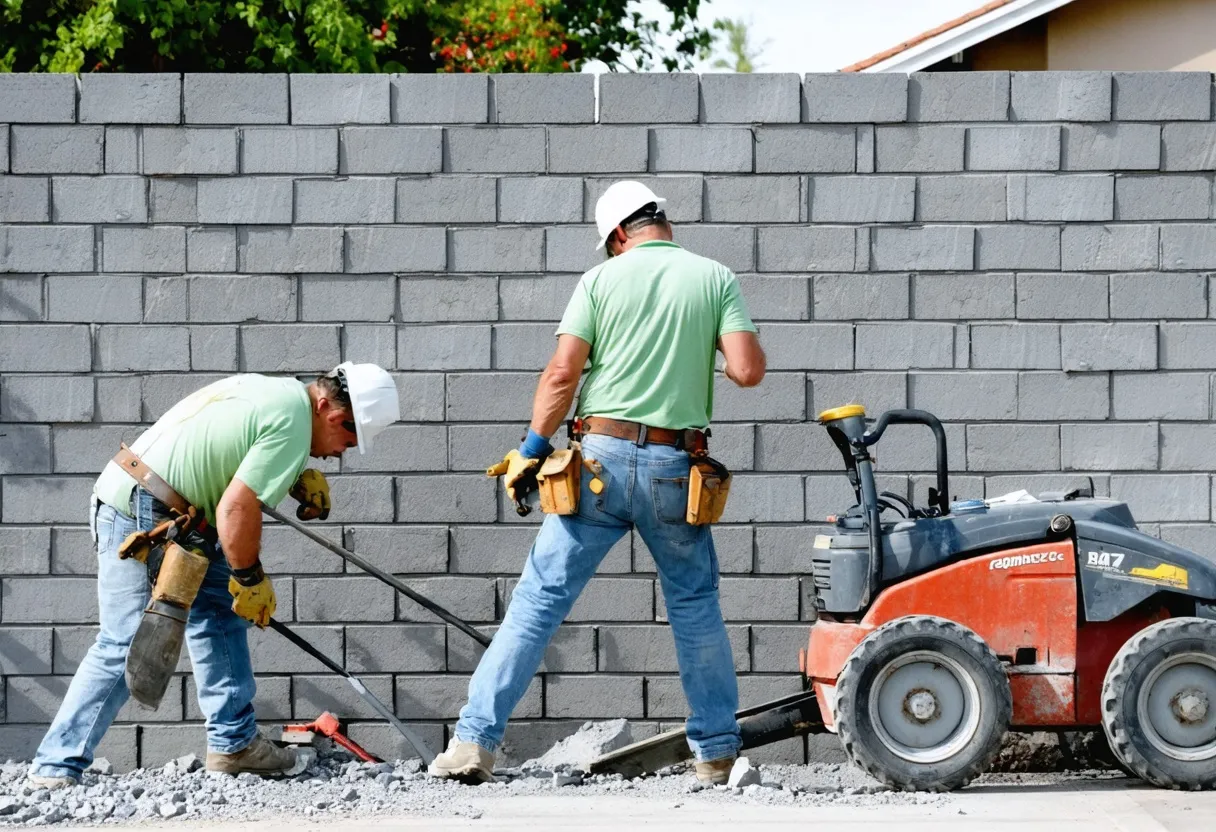
Block wall fencing is the backbone of Chandler backyards — it's the material behind pool safety compliance, HOA-approved side and rear yards, and fences that shrug off the Sonoran Desert's UV load year after year. If you're comparing quotes for a block wall fencing project in Chandler, the two things that actually decide whether the job goes smoothly are the ones most contractor sites never mention up front: what the wall will really cost, and whether the design will pass Chandler's pool-barrier requirements the first time. We lead with both. Every estimate we hand you is itemized before a single block is laid, and every plan involving a backyard pool is checked against Chandler's code before we submit for permit. You can see how we structure pricing on our Chandler fence cost breakdown, and everything below explains what goes into a block wall, a masonry fence, or a cinder block wall built to last in this climate.
What "Block Wall Fencing" Actually Includes
Block wall, masonry fence, and cinder block wall are terms Chandler homeowners use interchangeably, but there are real construction differences worth understanding before you sign a contract.
- CMU (concrete masonry unit) block — the standard 6″ or 8″ hollow concrete block, the most common and most economical choice for a full perimeter or pool-enclosure wall.
- Slump block — a textured, irregular-faced block that mimics adobe or hand-formed masonry; popular for front-facing walls and entry monuments where curb appeal matters.
- Decorative / split-face block — a rough-hewn textured face used to break up long expanses of wall or to match an existing HOA wall pattern.
- Stucco-finished block — standard CMU block finished with a stucco coat and painted to match the home, the most common look in Chandler subdivisions built from the 1990s onward.
- Combination walls — block pilasters or a block base topped with wrought iron or view fencing, used where homeowners want the security of masonry with visibility through the top section.
All of these are built on a poured concrete footing with vertical steel reinforcement run through the block cores and grouted solid at engineered intervals — not just stacked and mortared. That structural detail is what separates a wall that stays plumb through decades of desert heat cycling from one that cracks or leans within a few summers.
Chandler's Pool Fencing Code: What You Need to Know Before You Build
If your block wall will enclose or border a swimming pool or spa, it isn't optional design — it's a code requirement, and it's the single most common reason a Chandler fence project gets held up at inspection. Chandler requires a barrier at least 6 feet but no more than 7 feet around a pool area, and that barrier must be masonry or another approved decorative material, not a flimsy or easily climbed fence. Any gate in that barrier must be self-latching. A permit is required before construction begins.
We build to this standard as a matter of course on every pool-adjacent project, and we handle the permit submission so you're not the one deciphering code language or making a second trip to the counter because a plan got kicked back. If your project touches a pool wall, this is the first thing we confirm during your estimate — not something we discover after the footings are poured.
Our Block Wall Installation Process
A block wall is a permanent structure, so the process is more involved than stretching chain link or hanging a wood panel. Here's how a typical Chandler block wall project goes from first call to finished wall:
- On-site estimate and design consultation. We walk the property line with you, discuss height, finish, and whether any section borders a pool, and give you an itemized, written price before any work starts — no verbal ballpark that changes later.
- Permit and HOA review. Most Chandler jurisdictions require a permit for masonry walls above a certain height, and many communities also require HOA design approval. We prepare the drawings and handle submission.
- Utility locates and layout. We call for utility locates before any digging and stake the exact wall line so you can confirm it matches your expectations before footings go in.
- Footing excavation and forming. We dig to the engineered depth for a continuous concrete footing, sized to the wall height and local soil conditions, and set vertical rebar dowels before pouring.
- Block laying and reinforcement. Block courses go up on the cured footing with vertical steel run through the cores at engineered spacing and horizontal joint reinforcement between courses for lateral strength.
- Grouting and cell filling. Reinforced cells are filled solid with grout so the wall behaves as one structural unit rather than a stack of loose block — this is the step that gets skipped by corner-cutting crews and is the first thing that fails later.
- Cap block and finish. A cap course sheds water off the top of the wall, and if you've chosen a stucco or painted finish, that goes on once the wall has cured.
- Gate hardware and final walkthrough. Any gates are hung, hardware is set and tested (including self-latching hardware on pool-adjacent gates), and we walk the finished wall with you before calling it complete.
- Inspection. For permitted work, we coordinate the final inspection so you have documentation the wall meets code — important both for peace of mind and for any future home sale.
Comparing Fence Materials Available in Chandler
Block wall isn't the right choice for every application, and a contractor who only sells one material isn't giving you the full picture. Here's how the common options stack up for Chandler properties, where intense desert sun and occasional strong winds are the main durability test any fence has to pass.
Wood
Wood fencing gives a warmer, more traditional look and is usually the lowest up-front cost for a privacy fence. In Chandler's climate, though, sun exposure dries and splits boards faster than in milder climates, and wood is the material most likely to need repair within a decade — warped pickets, split rails, and loosened posts are common on west- and south-facing runs that take the harshest afternoon sun.
Vinyl
Vinyl resists rot and insect damage and holds paint-free color for years, but lower-grade vinyl can become brittle and discolor under sustained UV exposure. It's a solid privacy option when a masonry wall isn't required or wanted.
Chain link
The most economical option for securing a yard, dog run, or side property line where privacy isn't the priority. Galvanized or vinyl-coated chain link holds up well in the desert with minimal maintenance, though it offers no privacy and is the easiest fence type to climb.
Wrought iron
Iron fencing gives an open, upscale sightline and pairs well with block pilasters for a combination wall. Its main vulnerability is rust at welds and joints if the powder coat is scratched or chips, so periodic touch-up is part of ownership.
Composite
Composite fencing combines the low-maintenance profile of vinyl with a wood-grain appearance, and generally handles UV exposure better than natural wood without the periodic staining wood requires.
Aluminum
Aluminum fencing is a lighter-weight, rust-proof alternative to iron, often used for pool enclosures where code allows an approved open-style barrier. It won't rust the way iron can, but it's less rigid and less resistant to impact.
Block wall / masonry
For Chandler's climate and for pool-adjacent applications specifically, block wall is the most durable choice on this list. It doesn't rot, rust, warp, or need repainting on any regular schedule, it provides the most privacy and sound buffering of any option, and it's the material Chandler's pool barrier code is written around. The tradeoff is higher up-front cost and a longer install timeline than a panel fence — which is exactly why getting an accurate, itemized quote up front (see our fence cost guide for Chandler) matters more for this material than any other.
Common Fence Damage and Issues We Repair
Whether you already have a block wall or another fence type on your property, most of the repair calls we get fall into a handful of categories:
- Wood rot and insect damage at post bases and bottom rails, usually where irrigation or sprinkler spray keeps wood damp.
- Rust on iron fence welds, hinges, and chain-link fittings, especially where a powder coat has chipped and exposed bare metal to the elements.
- Warping and splitting in wood pickets and rails from repeated expansion and contraction under intense sun.
- Sagging gates and panels from settled or rotted posts, worn hinges, or foundations that were never set deep enough to begin with.
- Broken or missing boards and pickets from wind events or general age.
- Cracked mortar joints, spalling block, or leaning wall sections from tree root intrusion, impact damage, settling soil, or walls that were built without adequate steel reinforcement in the first place.
Our Fence Repair Process
Repair work follows its own process, separate from new installation, because the goal is targeted correction rather than rebuilding from scratch:
- Diagnostic inspection. We identify not just the visible damage but the underlying cause — a leaning fence section, for example, is often a post problem, not a panel problem.
- Written repair scope and quote. You get a clear breakdown of what's being replaced versus repaired, with pricing before work begins.
- Material matching. For block wall repairs, we match block type, texture, and finish as closely as possible so a patched section doesn't stand out.
- Removal of damaged sections. Only the compromised material is removed — posts, boards, block courses, or hardware, as needed.
- Structural correction. Posts are reset in fresh concrete, block sections are rebuilt with proper steel and grout, and any underlying drainage or grading issue contributing to the damage is addressed.
- Finish and cleanup. Stain, paint, or stucco touch-up is applied to blend the repair, and the site is cleaned of debris before we consider the job done.
Commercial and Security Fencing in Chandler
Beyond residential yards, we handle fencing for Chandler warehouses, light-industrial sites, and commercial properties where security is the primary requirement:
- Warehouse and industrial perimeter fencing — typically taller chain link or welded-wire security fencing designed for large-area perimeter coverage.
- Anti-climb fencing — tighter mesh patterns and reduced hand/foothold spacing for sites where deterring intrusion is the main goal, often paired with restricted-access gates.
- Block wall security perimeters — for sites where a solid masonry perimeter is preferred over see-through fencing, block wall does double duty as a sound and sight barrier plus a physical security boundary.
- Commercial gate systems — sliding or swing gates sized for vehicle access, with options for keypad or card-access hardware.
Commercial quotes get the same itemized, no-surprises pricing approach as residential jobs, scoped to the site's actual security requirements rather than a one-size template.
Custom Fence Styles We Also Install
Not every Chandler property needs a full block wall, and we build a range of specialty styles depending on the property's use case:
- Cable railing fencing — horizontal steel cable strung between posts, popular for view lots and pool areas where an open sightline is wanted alongside code compliance.
- Wire fencing — utilitarian, economical fencing for boundary marking or light containment on larger lots.
- Farm and ranch-style fencing — rail-style fencing for horse property or larger acreage on Chandler's outer edges, built for durability over decorative appeal.
- Horizontal-style fencing — modern horizontal wood or composite board fencing, a popular upgrade look for front yards and side-yard privacy sections.
What Affects Block Wall Fencing Cost in Chandler
Block wall pricing depends on more variables than most panel fencing, which is exactly why a generic per-foot number quoted over the phone is rarely accurate. The main cost drivers are:
- Wall height — taller walls need deeper footings and more steel, and pool-adjacent walls have a code-driven minimum height.
- Block type and finish — standard CMU is the most economical; slump block, split-face, and stucco-and-paint finishes add cost.
- Linear footage and layout — corners, gates, and grade changes all add labor beyond a straight run.
- Site access and existing conditions — demolition of an old fence or wall, tight access for equipment, or terrain that complicates footing excavation all factor in.
- Permit and engineering requirements — taller or pool-adjacent walls typically require permitted, engineered plans, which is a real cost but avoids the far larger cost of a wall that fails inspection or has to be rebuilt.
- Gates and hardware — the number of gates and whether self-latching pool-code hardware is required.
We break every one of these line items out in your written estimate so you know exactly what you're paying for, rather than a lump sum with no explanation. For a full breakdown of typical price ranges by project type, see our Chandler fence cost guide. We also offer financing options for larger block wall projects — details are on our fence financing page.
Free, No-Obligation Estimates
Every project starts with a free, on-site estimate. We measure, discuss your goals, flag anything code-related (especially pool proximity), and leave you with a written, itemized quote — not a verbal figure that shifts once work begins. There's no pressure and no obligation to book on the spot. If you're comparing multiple contractor quotes, we'd rather you have ours in writing to compare line by line.
Why Chandler Homeowners and Businesses Choose Us
Two things set our approach apart in this market: transparent, itemized pricing given before work starts, and deep familiarity with Chandler's pool-fencing code so your project is designed right the first time instead of getting flagged at inspection. Beyond that, we stand behind the work — details on coverage are on our fence warranty page — and we make larger block wall projects manageable with flexible payment options. If you're weighing a full backyard wall against a smaller repair, our team can walk you through the tradeoffs honestly rather than upselling the biggest job on the list.
Get Your Free Quote
No obligation, no pressure — just a clear picture of cost and compliance.
More fencing services
Ready For A Fence That Fits Chandler?
Get a clear, upfront quote — including pool-code details if they apply to your property.